





Industrial Extruded Aluminum Heatsink
An industrial extruded aluminum heatsink is a heavy-wall finned cooler built for continuous-duty power electronics that run hot, dirty, and unattended — factory automation controllers, resistance welders, traction converters, UPS, and process drives.

- Product Introduction
An industrial extruded aluminum heatsink is a heavy-wall finned cooler built for continuous-duty power electronics that run hot, dirty, and unattended - factory automation controllers, resistance welders, traction converters, UPS, and process drives. Compared with a commercial-grade cooler, the industrial aluminum heatsink uses a thicker base, wider fin pitch (to resist dust blockage), and a salt-spray-rated anodized finish so the assembly holds its thermal budget through years of thermal cycling without derating. We extrude 6063-T5 and 6061-T6 bodies, machine the mounting features, and screen every batch for flatness, salt-spray, and vibration before it ships.

- Heavy-wall, continuous-duty build - thicker base and gusseted fins spread sustained load and survive thermal cycling
- Harsh-environment finish - 480 hr salt-spray anodizing; powder-coat option for coastal, chemical, and outdoor duty
- Vibration & shock screened - bolt-down mounting and screening for rail, mobile, and machine-tool service
- Sized to duty cycle, not peak - we calculate steady-state and cyclic temperature so you never over-spec or throttle
What Makes a Heatsink "Industrial-Grade" - and Why It Matters for Continuous Duty
A commercial cooler and an industrial extruded aluminum heatsink may look similar at a glance, but they are engineered to different rules. Commercial parts are sized to a peak power spike and a clean, 25°C lab. Industrial parts are sized to the duty cycle - the sustained watts a welding control or variable-frequency drive actually dissipates hour after hour in a 45°C panel with lint in the air. That is why an industrial aluminum heatsink carries a thicker base (to keep the mounting face flat under cyclic load), wider fin pitch (so dust and fibers do not bridge the channels), and a corrosion-rated finish (so coastal or chemical plants do not eat the cooler before the electronics fail).
We extrude the body from 6063-T5 for the best fin geometry and cost, or 6061-T6 when base stiffness or threaded-insert retention is the binding constraint, then machine the bolt-down feet and bosses to your drawing. Because the fins and base are one continuous aluminum section, heat conducts from the device into the fins with no bonded joint to loosen under vibration. The result is a cooler that holds its thermal budget for years - not one that throttles the first summer it runs at full load.
Engineering note for buyers: Tell us the sustained (not peak) dissipation, the duty cycle and ambient temperature, the enclosure type (sealed NEMA/IP, open panel, outdoor), and whether forced air is present. We return a steady-state and cyclic temperature estimate with margin against your device limit, and we flag when a wider pitch or a forced-air booster is needed for a dusty or sealed cabinet.
Product Overview
Three views of the same industrial extruded profile - the heavy cross-section from the die, a length with bolt-down feet and bosses, and a mounted view in a sealed enclosure with a power module and fan.

Cross-section
A heavy 6063-T5 base with short, wide, gusseted fins - built for sustained load, not peak spikes.

Fin bar
Heavy extrusion to length with integrated feet, bosses, and threaded inserts for bolt-down assembly.

Mounted
Module and cooling fan bolt to the heavy base; the assembly drops into a sealed, dusty, or outdoor enclosure.
Why Plant Engineers, Procurement, OEMs & Distributors Specify Our Industrial Profiles
For Plant & Controls Engineers
- No Summer Throttling
Sized to duty cycle and ambient, not lab peak. The wider pitch and heavy base keep your drive or welder inside its temperature limit through continuous shifts in a hot, dirty cabinet.
For Procurement Teams
- Avoid Recurring Field Returns
Salt-spray and vibration screening mean the cooler is not the weak link. Stable 6063-T5 pricing and a die library keep reorders predictable for MRO and production programs.
For Industrial Equipment OEMS
- Drop-in for Harsh Duty
Bolt-down feet, bosses, and threaded inserts let the assembly mount directly to your enclosure wall or chassis. Powder-coat and 480 hr anodizing cover coastal and chemical plants.
Technical Specifications
Reference industrial extruded aluminum heatsink build. Base thickness, fin pitch, feet, and finish are set to your duty cycle, enclosure, and environment.
| Parameter | Specification |
| Base Alloy | Aluminum 6063-T5 (default); 6061-T6 for higher base stiffness |
| Build Class | Industrial / heavy-wall, continuous-duty |
| Base Thickness | 6–30 mm typical (heavier than commercial); thicker for flatness under cyclic load |
| Fin Pitch | Wider default (dust-resistant); tuned to airflow & environment |
| Fin Height | 10–150 mm; matched to envelope and convection |
| Mounting Features | Integrated feet, bosses, threaded inserts, clearance holes (M3–M10) |
| Base Flatness | ≤ 0.1 mm typical; fly-cut available for tighter |
| Max Length | Up to ~1,500 mm in a single heavy extrusion; cut to spec |
| Surface Finish | Clear / black anodizing (480 hr salt-spray); powder-coat option |
| Thermal Resistance | ~0.25–3.5 °C/W depending on profile, size, and airflow |
| Operating Temp. Range | −40 °C to +120 °C (material); designed for continuous duty |
| Cooling Method | Natural convection or forced-air; ducted optional |
| Certifications | RoHS, REACH; ISO 9001; salt-spray & vibration test reports available |
Industrial Extruded Aluminum Heatsink Selection Guide
Pick the duty class and fin geometry that match your load, enclosure, and environment - over-spec wastes metal; under-spec throttles in August.
| Service Condition | Recommended Profile | Notes |
| Light panel, clean, forced-air | Standard heavy flat-fin | Thicker base than commercial; fan carries the load |
| Dusty / linty cabinet, passive | Wide-pitch heavy fin | Resists channel bridging; black anodize for emissivity |
| Sealed NEMA/IP enclosure | Tall heavy fin+forced-air booster | Convection limited; add fan or duct; verify enclosure rating |
| Costal/chemical/outdoor | Heavy fin + 480 hr anodize or powder-coat | Corrosion-rated finish is the priority |
| Vibration/mobile/rail | Heavy base+bolt-down feet+inserts | Screened for vibrtion;threaded inserts retain the device |
| High sustained wattage, ducted | Dense heavy fin, tight pitch, forced-air | Wider pitch pays off only if air is clean; confirm duty cycle |
Technical Differences: Industrial Extrusion vs Commercial-Grade&other Routes
The same extrusion process makes both commercial and industrial extruded aluminum heatsinks - the difference is the duty class and the finish. Here is how an industrial extrusion compares to a commercial-grade part and to the alternatives, so you can justify the spec on the record.
| Route/Class | Best For | Limit | Relative Cost (volume) |
| Industrial Extruded profile(this page) | Continuous-duty, dusty, corrosive, vibrating industrial power electronics | Heavy wall uses more alloy; fin aspect capped by die | Low-Med |
| Commercial extrusion | Clean, benign, peak-rated consumer/IT cooling | Throttles in hot/dusty duty; thinner base, lighter finish | Low |
| 6061-T6 extrusion | When base stiffness / insert retention binds | Lower conductivity (~167 W/m·K); harder thin fins | Low-Med |
| Skived fin | Highest flux density, compact flat base | Higher cost; not a standard heavy profile part | Medium–High |
| Welded/bonded assembly | Very large or mixed-material structures | Weld adds joint resistance and a fatigue point | Medium-High |
| Liquid cold plate | Extreme density or remote cooling | Far higher cost and complexity; leak boundary | Medium |
Rule of thumb for duty class: If the cooler lives in a sealed, dusty, coastal, or vibrating cabinet running near its rated watts for hours, specify the industrial extruded aluminum heatsink - heavy base, wider pitch, corrosion-rated finish, and vibration screening. A commercial part sized only to peak load will throttle or corrode long before the electronics fail, which is the most expensive way to save a few percent on the cooler.
Material Comparison: 6063 vs 6061 vs 1070 vs Copper vs Coating Choice
For an industrial aluminum heatsink, the alloy trade is conductivity, stiffness, and cost - but the finish choice matters as much in industry, because corrosion, not conductivity, often ends the part's life.
| Material | Thermal Conductivity | Density | Stiffness | Corrosion Resistance | Cost |
| Aluminum 6063-T5 | ~209 W/m·K | 2.70 g/cm³ | Medium | Good (anodized better) | Low |
| Aluminum 6061-T6 | ~167 W/m·K | 2.70 g/cm³ | High | Good | Low-Med |
| Aluminum 1070(pure) | ~226 W/m·K | 2.70 g/cm³ | Low | Good | Low-Med |
| Copper (C1100) | ~398 W/m·K | 8.96 g/cm³ | High | Needs plating | High |
| Black anodize | Emissivity ~0.8 (surface) | - | - | Excellent | Low step |
| Powder coat | Insulating layer (avoid on fin) | - | - | Excellent | Med |
Recommendation: Build the body from 6063-T5 for the lowest landed cost and the finest fins, step up to 6061-T6 only when stiffness or threaded-insert retention is the binding constraint, and reserve copper for a thin interface insert at the hottest device. For the finish, default to 480 hr salt-spray anodizing in any coastal, chemical, or outdoor duty - and apply powder coat to the base and feet only (never the fins, which would insulate them) where mechanical abuse is the risk.

Application
Factory Automation & PLC Power
Heavy-wall profiles cool servo drives, PLC power stages, and I/O in sealed control cabinets on the shop floor.
Resistance Welding & Induction
Continuous-duty SCR/IGBT welder controls and induction heaters dumping sustained watts need the heavy base.
Traction & Rail Converters
Bolt-down, vibration-screened profiles for auxiliary converters and braking choppers in rolling stock.
UPS & Power Protection
Rectifier and inverter stages in UPS and battery systems that must run at full load through a grid event.
Oil & Gas/Outdoor
Salt-spray and powder-coat rated coolers for wellhead, pipeline, and remote telecom power in harsh climates.
Machine Tools & Robotics
Spindle drives, robot controllers, and VFDs exposed to coolant mist, chips, and vibration.
Manufacturing Process Chain(Indstrial Heavy-Wall)
How a heavy-wall 6063-T5 billet becomes a finished, bolt-down, environment-rated heatsink.
01 EXTRUDED
Heavy-wall die
02 T5 Age
Air-cool+age
03 Cut
Sawn to spec
04 CNC Feet
Feet, bosses, inserts
05 Finish
480 hr anodiz/powder
06 Screen
Vibration / salt-spray
Quality Inspection (Testing & QC)
Industrial service demands evidence, not promises. Every industrial extruded aluminum heatsink ships against a plan that adds corrosion and vibration screening to the standard flatness, fin, and finish checks.
| Inspection Point | Method | Acceptance |
| Incoming material | Mill cert+spectrometer spot check | 6063-T5 / 6061-T6 per order; no off-grade billet |
| Base flatness | Surface plate / CMM | ≤ 0.1 mm typical; tighter with fly-cut on request |
| Mounting feet/ inserts | CMM / torque + thread gauge | Per drawing; insert pull-out and thread go/no-go pass |
| Fin height & pitch | Gauge + visual | Per drawing; no collapsed or bent fins |
| Anodizing / salt-spray | Eddy-current thickness+480 hr ASTM B117 sample | 8–15 µm typical; no white corrosion after test |
| Vibration / shock screen | Random vibration + half-sine shock on sample lot | No fin crack, no insert loosening, no finish defect |
| Thermal check (sample) | Bench test vs device simulation | Within quoted Rθ margin (report attached) |
| CoC / traceability | Batch record | Material cert, inspection report, RoHS/REACH |
For buyers: Ask for the batch inspection report, salt-spray log, and vibration-screen record with your first order. We issue a Certificate of Conformity (CoC) and can supply PPAP-level documentation for rail, automotive, or grid programs on request - including the records that matter most for field reliability: base-flatness, insert retention, and corrosion screening.

Cost Factors
What drives the price of an industrial extruded aluminum heatsink - and how to meet the duty-cycle budget without over-paying for capability you do not need.
| Factor | Effect on Cost | Buyer Tip |
| Alloy | 6063 < 6061 ≈ 1070 < copper-insert | Stay 6063-T5 unless stiffness or a gain forces 6061 |
| Wall/base thciness | Heavy wall = more alloy than commercial | Size to real duty, not worst-case; do not over-thicken |
| Fin geometry | Wider pitch uses less mass than dese fin | Wider pitch often wins for dusty/passive duty anyway |
| Mounting features | Feet, bosses, inserts add CNC | Standardize a foot pattern across a product family |
| Finish / corrosion | 480 hr anodize < powder-coat | Anodize for most; powder only base/feet where abused |
| Testing/ screening | Salt-spray+vibration add a step | Required for harsh duty; amortize across volume |
| Tooling / NRE | One-time die; zero if existing die fits | Ask us to match an existing heavy profile first |
Budget guidance: The cheapest compliant path is a 6063-T5 heavy-wall profile from an existing die, with 480 hr anodizing and a standard foot pattern - often no NRE. Reserve powder coat for when the base/feet face mechanical abuse, and a custom die for when no stock profile fits your envelope. The biggest avoidable cost is specifying a commercial part and then paying for field returns; size to duty cycle once and buy the right class.
Customization Process
From your device drawing and duty profile to a finished, environment-rated cooler. A typical industrial extruded aluminum heatsink program runs in seven steps.
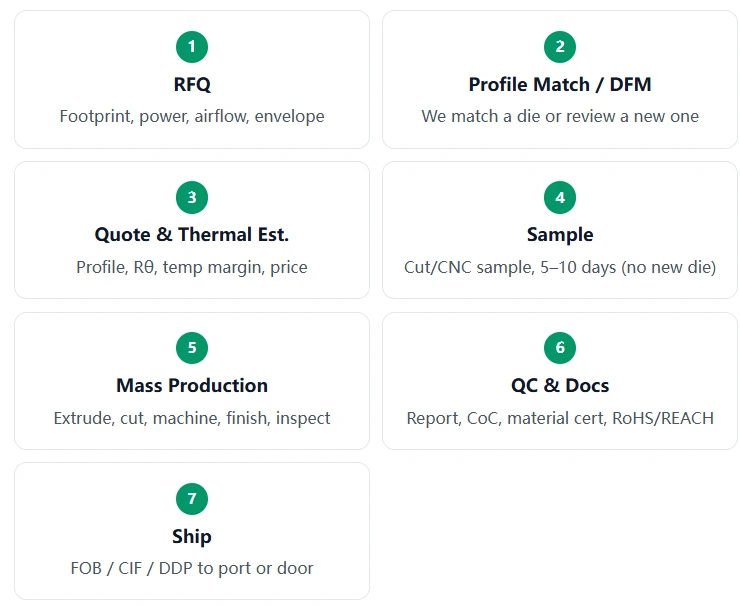
If an existing heavy-wall die already matches your envelope, we skip tooling entirely and samples can ship in 7–10 working days. A new custom die adds one-time NRE and lead time, confirmed in the quote and amortized across your volume. We default to 6063-T5 and flag explicitly in the quote when 6061-T6, 1070, or a copper insert is recommended for your load and environment.
What Customers Say

K. Schneider
Controls Engineer, Germany

A. Volkov
Power Electronics Lead, Russia

L. Ferreira
Procurement, Brazil
FAQ
Q: What is the difference between an industrial and a commercial extruded heatsink?
Both come from the same extrusion process, but an industrial extruded aluminum heatsink is sized and finished for continuous duty in harsh conditions: a thicker base to stay flat under cyclic load, a wider fin pitch so dust does not bridge the channels, a corrosion-rated finish (480 hr anodize or powder coat), and vibration screening. A commercial part is sized to a clean-lab peak and will throttle or corrode in a hot, dirty cabinet long before the electronics fail.
Q: How do you size an industrial cooler to my duty cycle?
Send the sustained (not peak) dissipation in watts, the duty cycle, ambient temperature, enclosure type (sealed NEMA/IP, open panel, outdoor), and whether forced air is present. We return a steady-state and cyclic temperature estimate with margin against your device limit, and flag when a wider pitch, forced-air booster, or corrosion-rated finish is needed.
Q: Why a wider fin pitch for dusty or passive duty?
Narrow fins maximize area in clean, forced-air ducts - but in a dusty cabinet or passive enclosure, lint and fibers bridge the channels and choke convection, raising temperature over time. A wider pitch on an industrial aluminum heatsink keeps airflow open through the life of the equipment, which usually wins over raw surface area in harsh duty.
Q: Which finish should I choose for coastal or chemical plants?
Default to 480-hour salt-spray anodizing (clear or black) for most coastal, chemical, and outdoor duty - it is the best corrosion resistance per cost. Apply powder coat to the base and feet only when mechanical abuse (tool contact, abrasion) is the risk. Never powder-coat the fins: the insulating layer would defeat the cooler. Copper is not a finish choice here; it is only a thin interface insert at the hottest device.
Q: 6063-T5 or 6061-T6 for the heavy-wall body?
Default to 6063-T5: better conductivity (~209 vs 167 W/m·K), better extrudability for fine fins, and lower cost. Choose 6061-T6 only when base stiffness or threaded-insert retention is the binding constraint and you can accept the ~20% conductivity drop. Most industrial extruded aluminum heatsinks never need 6061.
Q: What quality documents do you provide for industrial programs?
Every batch ships with a material certificate, inspection report (base flatness, fin height/pitch, feet/insert torque, anodizing thickness, sample Rθ), salt-spray log, vibration-screen record, and RoHS/REACH statement. We issue a Certificate of Conformity, and can supply PPAP-level documentation for rail, automotive, or grid programs on request.
Q: What is the MOQ and lead time?
Standard heavy-wall samples (no new die) ship in 7–10 working days with a low prototype MOQ. New custom extrusions add one-time NRE and tooling lead time, confirmed in the quote. Volume repeats run on a scheduled basis with tiered pricing for 1,000+ programs.
Hot Tags: industrial extruded aluminum heatsink, China, suppliers, manufacturers, factory, customized, wholesale, buy, price, free sample, Aluminum Extruded PCB Heat Sink, CNC machined heatsink, corrosion resistance heat sink, customized heat sink, extruded cooler, PCB cooler heat sink


