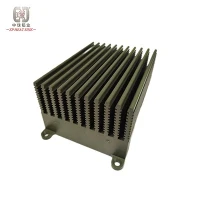



6063 Extruded Aluminum Heatsink
A 6063 extruded aluminum heatsink is the workhorse of the power-electronics cooling world — a finned cooler made by pushing heated 6063-T5 aluminum through a die so the base and fins are one continuous piece.

- Product Introduction
A 6063 extruded aluminum heatsink is the workhorse of the power-electronics cooling world - a finned cooler made by pushing heated 6063-T5 aluminum through a die so the base and fins are one continuous piece. We standardize on 6063-T5 because it offers the best of every property a heatsink needs: excellent extrudability for thin, dense fins, high thermal conductivity (~209 W/m·K), a clean and uniform anodized surface, and the lowest landed cost. That is why a 6063-T5 heatsink is the default choice for LED modules, IGBT baseplates, power supplies, and inverters - and why we stock dies and build to your length, hole pattern, and finish.
- 6063-T5 is the default alloy - best extrudability of the common heat-treatable grades, so fins can be thin and closely spaced
- One-piece extrusion - base and fins are continuous 6063 aluminum, no bonded joint to resist heat flow
- Clean anodizing - 6063 takes clear and black anodizing evenly, including long lengths
- Lowest cost at volume - 6063 billet is economical and the die library lets many projects skip tooling
Why 6063-T5 Is the Standard Alloy for Extruded Aluminum Heatsinks
When engineers specify an extruded 6063 heatsink, they are choosing an alloy that happens to be ideal for the job. 6063 is an Al-Mg-Si (aluminum-magnesium-silicon) heat-treatable grade with the highest extrudability of the common alloys - meaning it flows through a die at lower pressure and fills thin, tall fin cavities that would crack or short-fill with stiffer grades. That single property is what lets a 6063 aluminum extrusion heatsink carry fine, closely spaced fins, which is where most of the cooling surface area comes from.
After extrusion, the profile is cooled and artificially aged to the T5 temper: medium strength, stable dimensions, good corrosion resistance, and a surface that anodizes to a bright, even finish. The result is a cooler that conducts heat well (~209 W/m·K), weighs little, finishes cleanly, and costs less than any alternative - which is why 6063-T5 is the default for everything from LED coolers to IGBT baseplates to power-supply lids.
Engineering note for buyers: Send the device footprint, total dissipation (W), ambient temperature, available envelope (length × width × height), and whether cooling is natural or forced-air. We confirm 6063-T5 is sufficient (it almost always is) or flag when 6061-T6, 1070, or a copper insert is warranted - then return a case-/surface-temperature estimate and margin before any tooling commitment.
Product Overview
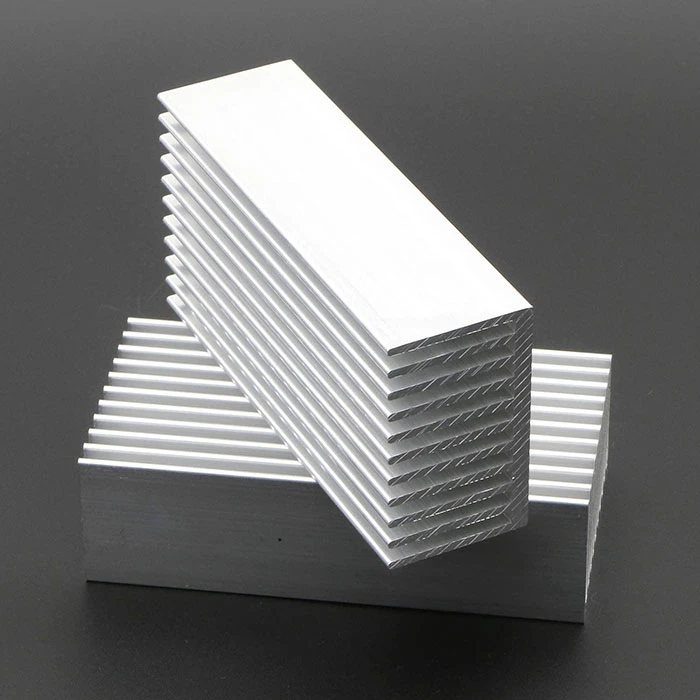
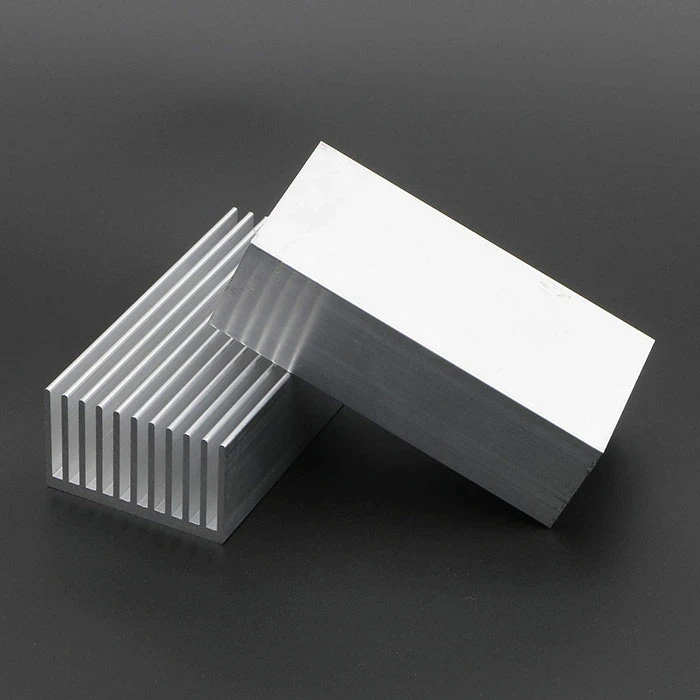
Three views of the same 6063-T5 extruded profile - the cross-section that comes out of the die, a sawn length showing the repeated fins, and a mounted view with the alloy grade marked and convective airflow.

Cross-section
The die output: a flat 6063-T5 base with straight perpendicular fins, one continuous section.
Full bar
Extruded 6063-T5 to length; thin fins repeat for maximum surface area.
Mounted
Device bolts to the 6063-T5 base; heat spreads into fins and convects away.
Why Procurement, Engineers, OEMs & Distributors Specify Our 6063-T5 Profiles
For Procurement Teams
- Stable Cost, No Surprises
6063-T5 is the most economical of the heat-treatable alloys and our die library means many projects need no new tooling. Forecasting is stable and reorders are price-predictable.
For Thermal & Mechanical Engineers
-Known Alloy, Verifiable Rθ
6063-T5 conductivity (~209 W/m·K) and T5 hardness are documented per batch. Send the footprint and load; we return a temperature estimate and margin before tooling.
For Power-Electronics OEMs
- Drop-in for IGBT, SSR, PSU, LED
6063-T5 profiles bolt straight to modules and supplies, carry the typical case-to-air load at the lowest weight and cost, and finish cleanly for visible or sealed assemblies.
Technical Specifications
Reference 6063 extruded aluminum heatsink build. Length, hole pattern, and finish are set to your device and envelope; 6061-T6 or 1070 can be substituted where the application demands it.
| Parameter | Specification |
| Base Material | Aluminum 6063-T5 (default); 6061-T6 or 1070 on request |
| Thermal Conductivity (6063-T5) | ~209 W/m·K |
| Alloy Temper | T5 (cooled + artificially aged after extrusion) |
| Fin Height | 5–120 mm typical; matched to envelope and airflow |
| Fin Pitch/Density | Custom; 6063 enables thin, closely spaced fins (tight pitch for forced air) |
| Min. Fin Wall Thickness | ~0.8 mm typical (6063 extrudability supports thin walls) |
| Base Thickness | 3–20 mm typical; thicker for flatness and high load |
| Base Flatness | ≤ 0.1 mm across the mounting face (fly-cut available for tighter) |
| Max Length | Up to ~1,200 mm in a single extrusion; cut to spec |
| Post-Extrusion Work | Saw cut, CNC holes/threads/flats, anodizing, deburr |
| Surface Finish | Natural; clear or black anodizing; optional chromate |
| Thermal Resistance | ~0.3–4.0 °C/W depending on profile, size, and airflow |
| Cooling Method | Natural convection or forced-a |
6063 Extruded Aluminum Heatsink Selection Guide
6063-T5 fits the large majority of fin-profile applications. Pick the profile family and fin geometry that match your device and airflow.
| Mounting Face/Device | Recommended 6063 Profile | Notes |
| Flat module - IGBT, SSR, MOSFET, power module | Flat-back straight-fin | Most common; bolt to base, fins up; forced air for high load |
| Corner/enclosure wall | Angle(L) profile | Base wraps a cornver; saves envelope in thight boxes |
| Cylindrical device-LED, motor, tube | Round/sunflower profile | Hollow bore seats the device; 360° fins |
| Low-profile, height-limited supply | Short flat-fin or dense-fin profile | Trade height for fin count; natural or light forced air |
| Sealed cabinet, passive onlny | Tall straight-fin, wider pitch | Maximize natural-convection area; black anodize for emissivity |
| High flux, forced-air duct | Dense straight-fin, tight pitch | Fan pushes air through channels; 6063 thin walls pays off |
Technical Differences: 6063 Extrusion vs Other Routes & Alloys
A 6063-T5 extruded heatsink is the lowest-cost, most repeatable route for most fin-profile cooling - but it is worth seeing how the alloy and the process compare, so you can justify the choice on the record.
| Route | Best For | Limit | Relative Cost (volume) |
| 6063-T5 extrusion (this page) | Most power electronics, LED, drives, inverters at volume | Fin aspect ratio capped by die; not complex non-extrudable shapes | Low |
| 6061-T6 extrusion | When higher base stiffness/strength is needed | Lower conductivity (~167 W/m·K), harder to extrude thin fins | Low-Med |
| 1070 (pure) extrusion | Small conductivity gain where strength is not critical | Softer; dents and bends more easily | Low-Med |
| Skived fin (6063/1070) | Highest flux density, compact, flat base | Higher cost; not a standard-profile part | Medium-High |
| Bonded/folded fin | Tall or copper fins on aluminum base | Internal bond adds resistance and a failure point | Medium |
| Die-cast | Complex non-extrudable shapes in one shot | Lower conductivity (~96 W/m·K); coarser fins | Medium |
| Heat-pipe / liquid cold plate | Extreme density or remote cooling | Far higher cost and complexity | High |
Rule of thumb: Specify 6063-T5 for the body whenever a straight, angle, or round fin fits your device and you need volume - it is the best balance of extrudability, conductivity, finish, and cost. Move to 6061-T6 only when base stiffness is the binding constraint, to 1070 only for a small conductivity gain you can justify against the softness, and to skived or liquid cooling only when flux density or envelope rules out extrusion.
Material Comparison: 6063 vs 6061 vs 1070 vs Copper vs Die-Cast
For an aluminum 6063 heatsink, the alloy trade is conductivity, stiffness, and cost. Copper conducts far better but is heavy and costly and is almost never the whole body; die-cast aluminum buys shape flexibility at a steep conductivity loss.
| Material | Thermal Conductivity | Density | Strength | Extrudability | Cost |
| Aluminum 6063-T5 | ~209 W/m·K | 2.70 g/cm³ | Medium | Excellent (thin fins) | Low |
| Aluminum 6061-T6 | ~167 W/m·K | 2.70 g/cm³ | High | Good (thicker fins) | Low-Medium |
| Aluminum 1070(pure) | ~226 W/m·K | 2.70 g/cm³ | Low | Good | Low-Medium |
| Copper (C1100) | ~398 W/m·K | 8.96 g/cm³ | High | Poor (not extruded) | High |
| ADC12 die-cast | ~96 W/m·K | 2.65 g/cm³ | Medium | N/A (cast) | Medium |
Recommendation: Build the extruded body from 6063-T5 for the lowest landed cost and the finest fins. Use 6061-T6 when base stiffness or threaded-insert retention matters more than the ~20% conductivity difference, 1070 when you want a modest conductivity lift and can accept softer material, and reserve copper for a thin interface insert at the hottest spot rather than the entire profile. Die-cast only when the shape simply cannot be extruded.
Application
Power Modules & IGBT / SSR
6063-T5 flat profiles bolt straight to IGBT, SSR, MOSFET, and rectifier modules in drives and inverters.
LED Lighting
Low-profile 6063 fins cool high-power LED modules, drivers, and COB arrays with passive or light forced air.
Motor Drives & VFD
Angle and flat 6063 profiles manage IGBT heat in variable-frequency drives and servo amplifiers.
Power Supplies & SMPS
Short dense-fin 6063 profiles fit inside supply enclosures; flat profiles double as lids.
Solar & Energy-Storage Inverters
Tall 6063 straight-fin profiles carry sustained inverter load in sealed outdoor cabinets.
Industrial & Enclosure Cooling
Standard 6063 profiles drop into control boxes, DIN-rail modules, and instrument housings.
Manufacturing Process (6063-T5)
How a 6063 billet becomes a finished, device-ready heatsink - the T5 temper is set right after extrusion.
01 Homogenize
6063 billet pre-heat
02 Extrude
Push through die
03 T5 Age
Air-cool+artificial age
04 Cut
Sawn to spec
05 CNC
Holes, threads, flats
06 Anodize
Natural or black
Quality Inspection (Testing & QC)
Every 6063 extruded aluminum heatsink ships against an inspection plan focused on the points that drive fit and thermal performance: alloy confirmation, T5 temper, mounting-face flatness, fin consistency, and finish.
| Inspection Point | Method | Acceptance |
| Incoming alloy | Mill cert+spectrometer spot check | 6063 per order; no off-grade billet |
| T5 temper/hardness | Webster/Brinell on sample | Within 6063-T5 band (logged per batch) |
| Base flatness | Surface plate / CMM | ≤ 0.1 mm typical; tighter with fly-cut on request |
| Fin height & pitch | Gauge + visual | Per drawing; no collapsed or bent fins |
| Hole position / thread | CMM/thread gauge | Per drawing; thread go/no-go pass |
| Anodizing thickness | Eddy-current coating gauge | 8–15 µm typical; logged per batch |
| Thermal resistance (sample) | Bench test vs device simulation | Within quoted Rθ margin (report attached) |
| Visual & burr | 100% visual, deburr check | No sharp edge, no finish defect |
| CoC / traceability | Batch record | Material cert, inspection report, RoHS/REACH |
For buyers: Ask for the batch inspection report and material certificate with your first order - we issue a Certificate of Conformity (CoC) and can supply PPAP-level documentation for automotive or grid programs on request, including the 6063 alloy spectrometer record and T5 hardness values that matter for traceability.

Cost Factors
What drives the price of a 6063 extruded aluminum heatsink - and how to specify one that meets the thermal budget without paying for unused capability.
| Factor | Effect on Cost | Buyer Tip |
| Alloy | 6063 < 6061 ≈ 1070 < copper-insert | Stay 6063-T5 unless stiffness or a gain forces 6061/1070 |
| Profile size | Taller / longer / wider = more aluminum | Size to real envelope, not worst-case |
| Fin density | Denser fins = more extrusion mass | Match pitch to airflow; don't over-fin |
| Tooling / NRE | One-time die; zero if existing die fits | Ask us to match an existing profile first |
| CNC machining | Holes, threads, flats add setup | Reuse a standard hole pattern where possible |
| Anodizing | Black anodize adds a step | Natural finish is fine unless emissivity matters |
| Order quanity | Volume pricing at 1,000+ | Prototype MOQ is low; lock volume price early |
Budget guidance: The cheapest path is a 6063-T5 standard profile from an existing die with natural finish and a standard hole pattern - often no NRE at all. Specify black anodizing only when emissivity is a real factor, and reserve a custom die for when no stock profile fits your envelope. Volume pricing kicks in at 1,000+ pieces.
Customization Process
From your device drawing to a finished extruded profile. A typical extruded aluminum profile heatsink program runs in seven steps.
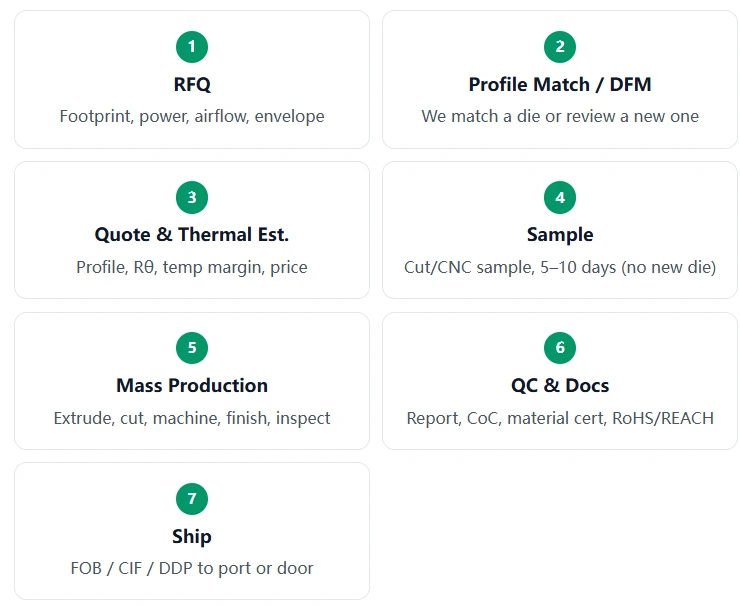
If an existing die already matches your envelope, we skip tooling entirely and samples can ship in 5–7 working days. A new custom die adds one-time NRE and lead time, which we confirm in the quote and amortize across your volume. We default the body to 6063-T5 and flag explicitly in the quote if 6061-T6, 1070, or a copper insert is recommended for your specific load.
What Customers Say

T. Andersen
Power Electronics Engineer, Denmark

R. Mehta
Procurement, India

P. Kowalski
Lighting OEM, Poland
FAQ
Q: Why is 6063 the standard alloy for extruded heatsinks?
A: 6063 is an Al-Mg-Si heat-treatable grade with the best extrudability of the common alloys, so it flows into thin, tall, closely spaced fins that stiffer grades (like 6061) cannot fill reliably. It also conducts well (~209 W/m·K), finishes cleanly under anodizing, and is economical. For a 6063-T5 heatsink, the T5 temper adds medium strength and dimensional stability without compromising those traits - which is why 6063-T5 is the industry default.
Q: What is the thermal conductivity of 6063 aluminum?
A: 6063-T5 has a thermal conductivity of about 209 W/m·K - higher than 6061-T6 (~167 W/m·K) and close to pure 1070 (~226 W/m·K). It is far above die-cast aluminum (~96 W/m·K). For a 6063 aluminum heatsink, this is more than enough to carry the typical case-to-air load of IGBTs, LEDs, supplies, and inverters.
Q: 6063 vs 6061 - which should I choose?
A: Default to 6063-T5: better conductivity, better extrudability (finer fins), and lower cost. Choose 6061-T6 only when base stiffness or threaded-insert retention is the binding constraint and you can accept the ~20% conductivity drop. Most extruded 6063 heatsink applications never need 6061.
Q: What does the T5 temper mean?
A: T5 means the profile is cooled from the extrusion temperature and then artificially aged (precipitation-hardened) - but not solution-heat-treated. It gives medium strength and stable dimensions at low process cost, which is exactly what a heatsink needs. T6 (solution-treated + aged) is stronger but adds cost and is rarely required for a 6063-T5 heatsink.
Q: Should I use copper instead of 6063 for the whole body?
A: Almost never. Copper conducts ~398 W/m·K but is 3.3× denser and far more expensive, and it is not extrudable into fin profiles. For an aluminum 6063 heatsink, copper is best used as a thin interface insert at the single hottest spot - not as the body. The 6063 body plus a small copper insert beats an all-copper cooler on weight, cost, and manufacturability in nearly every case.
Q: How do you size the cooler to my device?
A: Send the device footprint, total dissipation in watts, ambient temperature, available envelope, and whether cooling is natural or forced-air. We either match a standard 6063 profile or propose a custom die, then return a surface-temperature estimate and margin before any tooling commitment.
Q: What quality documents do you provide?
A: Every batch ships with a 6063 alloy material certificate (including spectrometer record), T5 hardness value, inspection report (base flatness, fin height/pitch, hole position, anodizing thickness, sample Rθ), and RoHS/REACH statement. We issue a Certificate of Conformity, and can supply PPAP-level documentation for automotive or grid programs on request.
Hot Tags: 6063 extruded aluminum heatsink, China, suppliers, manufacturers, factory, customized, wholesale, buy, price, free sample, Aluminum Extruded PCB Heat Sink, custom heatsink, customized shape heat sink, heat sink extrusion, large heat sink, round heat sink extrusion