

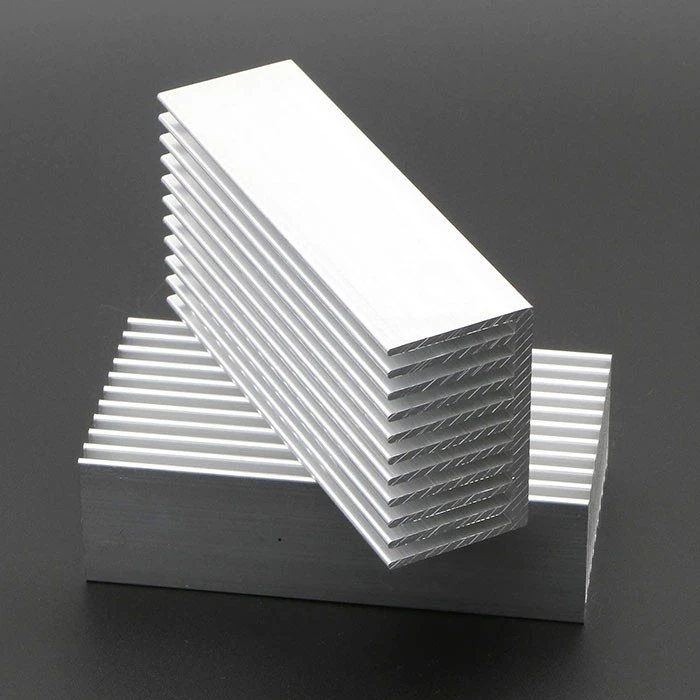
Extruded Aluminum Profile Heatsink
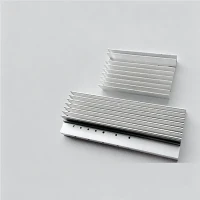
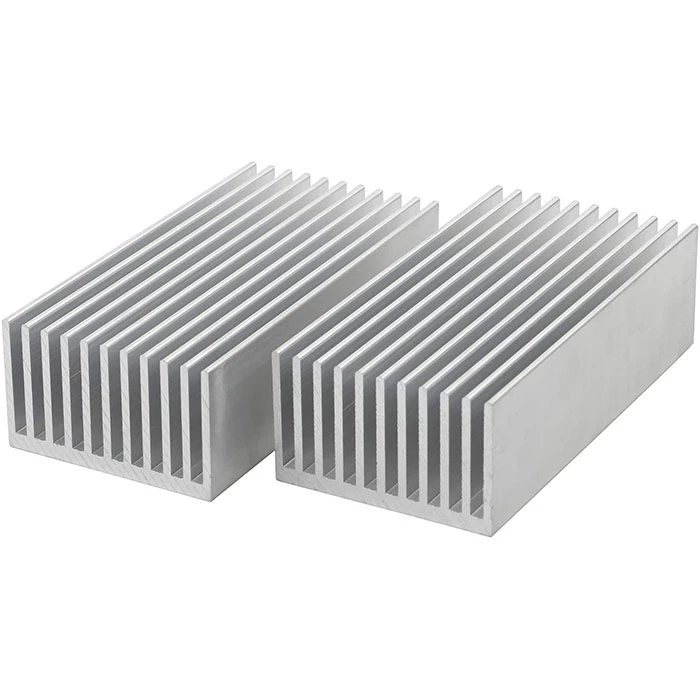
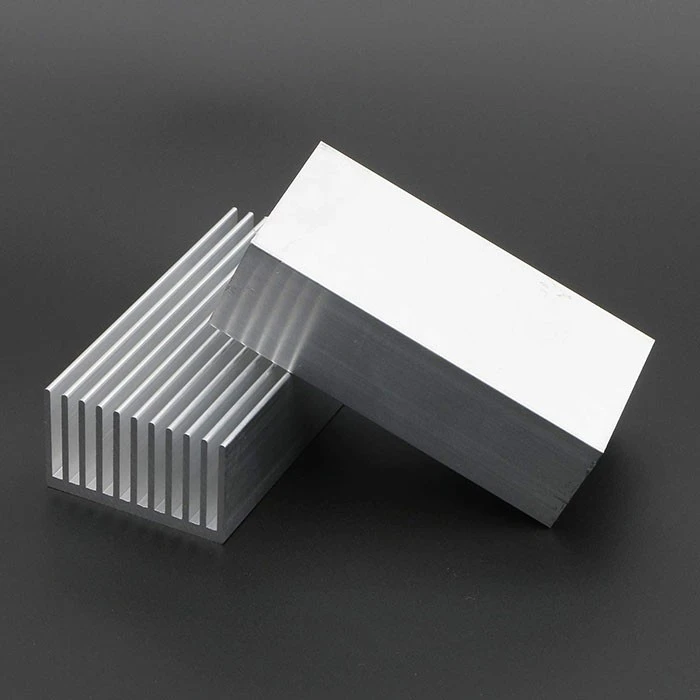
An extruded aluminum profile heatsink is a finned aluminum section produced by pushing heated 6063 or 6061 billet through a die, so the base plate and the cooling fins are one continuous piece — no bonding, no weld, no interface resistance inside the part.

- Product Introduction
An extruded aluminum profile heatsink is a finned aluminum section produced by pushing heated 6063 or 6061 billet through a die, so the base plate and the cooling fins are one continuous piece - no bonding, no weld, no interface resistance inside the part. Standard profiles (flat-back straight-fin, angle/L, and round) cover the large majority of power-electronics, LED, drive, and inverter cooling needs at the lowest tooling cost and the highest production repeatability. We stock and build extruded aluminum profile heatsinks to your length, hole pattern, and finish - or match you to an existing die to skip tooling entirely.
- One-piece extrusion - base and fins are continuous aluminum, so heat moves from device to fin with no internal joint
- Standard profile families - flat-back straight-fin, angle/L, and round, each suited to a different mounting face
- Lowest tooling, fastest sampling - an existing die means days, not weeks; new dies amortize across volume
- Fully workable - cut to length, CNC holes/threads/flats, and anodize to your spec after extrusion
What an Extruded Aluminum Profile Heatsink Is - and Why Extrusion Is the Baseline
Most aluminum heatsinks in the world start as an extruded aluminum profile. A heated aluminum billet is forced through a steel die that shapes a constant cross-section: a flat or shaped base with fins standing up from it. Sawed to length and optionally CNC-machined and anodized, that single extruded bar becomes the cooler. Because the fins and base are the same continuous aluminum, heat conducts from the mounted device straight up into the fins with no bonded interface to resist it.
Extrusion sits at the sweet spot of cost, volume, and performance. Compared with die-casting it gives higher thermal conductivity and finer fins; compared with skiving or CNC-from-solid it is far cheaper at volume; compared with bonded/folded-fin assemblies it removes an internal joint that could fail or add resistance. That is why an aluminum heatsink extrusion is the default for everything from LED modules to IGBT baseplates to power-supply lids - and why we keep a library of standard dies so many projects need no new tooling at all.
Engineering note for buyers: Send the device footprint, total dissipation (W), ambient temperature, available envelope (length × width × height), and whether cooling is natural or forced-air. We either match you to an existing standard extruded heatsink profile or propose a custom die, then return a case-/surface-temperature estimate and margin before any tooling commitment.
Product Overview
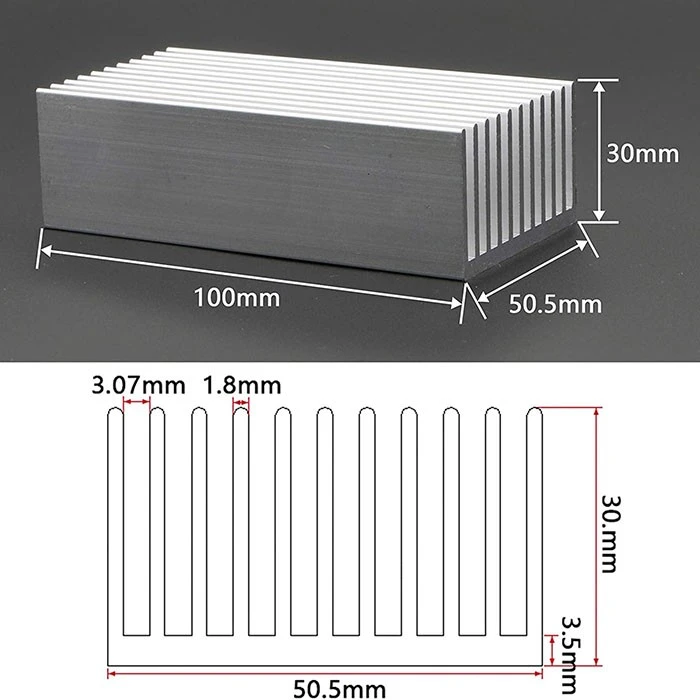
Three views of the same extruded profile - the cross-section that comes out of the die, a sawn length showing the repeated fins, and a mounted view with a device on the base and convective airflow.

Cross-section
The die output: a flat base with straight perpendicular fins, one continuous section.
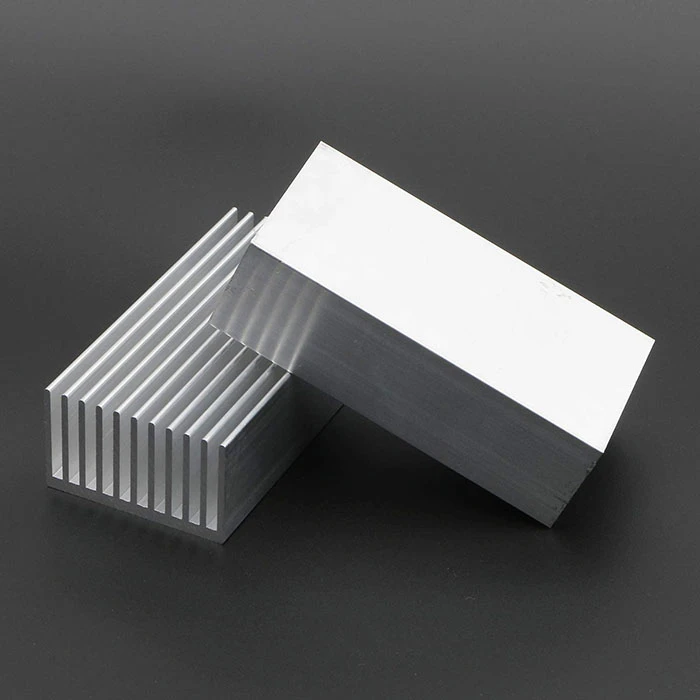
Full bar
Extruded to length; fins repeat along the whole section for maximum surface area.
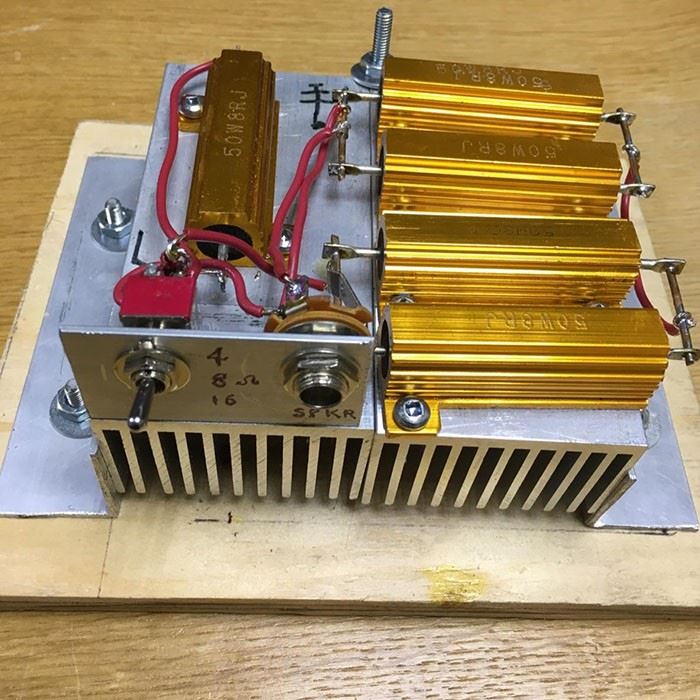
Mounted
Device bolts to the base; heat spreads into fins and convects away. Add a fan for forced air.
Why Procurement, Engineers, OEMs & Distributors Specify Our Extruded Profiles
For Procurement Teams
- Low Tooling, Predictable Cost
A standard extruded heatsink profile from our die library means no NRE. Even a new die amortizes across volume, so unit cost stays low and forecasting is stable across reorders.
For Thermal & Mechanical Engineers
- Known Geometry, Verifiable Rθ
Extruded profiles give repeatable fin pitch, base flatness, and thermal resistance we can quote against. Send the footprint and load; we return a temperature estimate before tooling.
For Power-Electronics OEMs
- Drop-in for IGBT, SSR, PSU, LED
Flat-back straight-fin profiles bolt straight to modules and supplies; angle profiles wrap a corner; round profiles seat cylinders. Pick the family that matches your mounting face.
Technical Specifications
Reference extruded aluminum profile heatsink build. Length, hole pattern, and finish are set to your device and envelope.
| Parameter | Specification |
| Base Material | Aluminum 6063-T5 (default); 6061-T6 on request; 1070 for higher conductivity low-stress use |
| Profile Type | Standard extruded fin profiles-flat-back straight-fin, angle/L, round (see Selection Guide) |
| Fin Height | 5-120 mm typical; matched to envelope and airflow |
| Fin Pitch/Density | Custom; tighter for forced air, wider for passive or dusty environments |
| Base Thickness | 3-20 mm typical; thicker for flatness and high load |
| Base Flatness | ≤ 0.1 mm across the mounting face (fly-cut available for tighter) |
| Max Length | Up to ~1,200 mm in a single extrusion; cut to spec |
| Post-Extrusion | Saw cut, CNC holes/threads/flats, anodizing, deburr |
| Surface Finish | Natural; clear or black anodizing; optional chromate |
| Thermal Resistance | ~0.3–4.0 °C/W depending on profile, size, and airflow |
| Cooling Method | Natural convection or forced-air |
| Certifications | RoHS, REACH compliant; ISO 9001 manufacturing |
Extruded Aluminum Profile Heatsink Selection Guide
Pick the profile family that matches your mounting face and airflow, then size fin height and pitch to the load.
| Mounting Face/Device | Recommended Profile | Notes |
| Flat module - IGBT, SSR, MOSFET, power module | Flat-back straight-fin | Most common; bolt to base, fins up; forced air for high load |
| Corner/enclosure wall | Angle(L) profile | Base wraps a cornver; saves envelope in thight boxes |
| Cylindrical device-LED, motor, tube | Round/sunflower profile | Hollow bore seats the device; 360° fins |
| Low-profile, height-limited supply | Short flat-fin or dense-fin profile | Trade height for fin count; natural or light forced air |
| Sealed cabinet, passive onlny | Tall straight-fin, wider pitch | Maximize natural-convection area; black anodize for emissivity |
| High flux, forced-air duct | Dense straight-fin, tight pitch | Fan pushes air through channels; tighter pitch pays off |
Technical Differences: Extrusion vs Other Manufacturing Routes
An extruded aluminum profile heatsink is not the only way to make a cooler. The right route depends on flux density, volume, and envelope. Here is how extrusion compares to the alternatives.
| Route | Best For | Limit | Relative Cost (volume) |
| Extruded profile(this page) | Most power electronics, LED, drives, inverters at volume | Fin aspect ratio capped by the die; not round/complex shapes | Low |
| Skived fin | Highest flux density, compact, flat base | Higher cost; not a standard-profile part | Medium-High |
| Bonded/folded fin | Very tall or copper fins on aluminum base | Internal bond adds resistance and a failure point | Medium |
| Die-cast | Complex non-extrudable shapes in one shot | Lower conductivity (~96 W/m·K); coarser fins | Medium |
| CNC from solid plate | Prototypes, low volume, odd shapes | Expensive, slow, wastes material at volume | High |
| Heat-pipe / liquid cold plate | Extreme density or remote cooling | Far higher cost and complexity | High |
Rule of thumb: If a straight, angle, or round fin shape fits your device and you need volume, an extruded aluminum cooling fin profile is almost always the lowest-cost route with the best repeatability. Move to skived or liquid cooling only when flux density or envelope rules out extrusion; pick die-cast only when the shape simply cannot be extruded.
Material Comparison: 6063 vs 6061 vs 1070 vs Copper
For an extruded aluminum profile heatsink, the alloy trades conductivity, strength, and cost. Pure 1070 aluminum conducts slightly better than 6063 but is softer; copper conducts far better but is heavy and costly and is rarely the whole body.
| Material | Thermal Conductivity | Density | Cost | When to Use |
| Aluminum 6063-T5 | ~209 W/m·K | 2.70 g/cm³ | Low | Default for extruded profiles - extrudes cleanly, good finish |
| Aluminum 6061-T6 | ~167 W/m·K | 2.70 g/cm³ | Low-Med | When higher stiffness/strength at the base is needed |
| Aluminum 1070(pure) | ~226 W/m·K | 2.70 g/cm³ | Low-Med | Higher conductivity where strength is not critical |
| Copper (C1100) | ~398 W/m·K | 8.96 g/cm³ | High | Interface insert only; almost never the whole extruded body |
Recommendation: Specify 6063-T5 for the bulk of your extruded aluminum profile heatsink program - it extrudes into fine fins, finishes well, and carries the typical case-to-air load at the lowest landed cost. Use 6061-T6 when base stiffness matters, 1070 when you want a small conductivity gain and can accept softer material, and reserve copper for a thin interface insert at the hottest spot rather than the entire profile.
Application
Power Modules & IGBT / SSR
Flat-back straight-fin profiles bolt straight to IGBT, SSR, MOSFET, and rectifier modules in drives and inverters.
LED Lighting
Low-profile extruded fins cool high-power LED modules, drivers, and COB arrays with passive or light forced air.
Motor Drives & VFD
Angle and flat profiles manage IGBT heat in variable-frequency drives and servo amplifiers.
Power Supplies & SMPS
Short dense-fin profiles fit inside supply enclosures; flat profiles double as lids.
Solar & Energy-Storage Inverters
Tall straight-fin profiles carry sustained inverter load in sealed outdoor cabinets.
Industrial & Enclosure Cooling
Standard profiles drop into control boxes, DIN-rail modules, and instrument housings.
Manufacturing Process Chain
From aluminum billet to a finished, device-ready extruded profile.
01 EXTRUDED
6063/6061 Through die
02 Cut to Length
Sawn to your spec
03 CNC
Holes, threads, flats
04 Anodize
Natural or black
05 Deburr & Clean
Assembly-ready
06 Inspect
Flatness, fins, finish
Quality Inspection (Testing & QC)
Every extruded aluminum profile heatsink ships against an inspection plan focused on the points that drive fit and thermal performance: flatness of the mounting face, fin consistency, and finish.
| Inspection Point | Method | Acceptance |
| Incoming material | Mill cert+spectrometer spot check | 6063/6061/1070 per order; no off-grade alloy |
| Base flatness | Surface plate / CMM | ≤ 0.1 mm typical; tighter with fly-cut on request |
| Fin height & pitch | Gauge + visual | Per drawing; no collapsed or bent fins |
| Hole position / thread | CMM / thread gauge | Per drawing; thread go/no-go pass |
| Anodizing thickness | Eddy-current coating gauge | 8–15 µm typical; logged per batch |
| Thermal resistance (sample) | Bench test vs device simulation | Within quoted Rθ margin (report attached) |
| Visual & burr | 100% visual, deburr check | No sharp edge, no finish defect |
| CoC / traceability | Batch record | Material cert, inspection report, RoHS/REACH |
For buyers: Ask for the batch inspection report and material certificate with your first order - we issue a Certificate of Conformity (CoC) and can supply PPAP-level documentation for automotive or grid programs on request, including base-flatness records that matter most for direct device mounting.

Cost Factors
What drives the price of an extruded aluminum profile heatsink - and how to specify one that meets the thermal budget without paying for unused capability.
| Factor | Effect on Cost | Buyer Tip |
| Material | 6063 < 6061 ≈ 1070 < copper-insert | Stay 6063 unless stiffness or a small gain forces 6061/1070 |
| Profile size | Taller / longer / wider = more aluminum | Size to real envelope, not worst-case |
| Fin density | Denser fins = more extrusion mass | Match pitch to airflow; don't over-fin |
| Tooling / NRE | One-time die; zero if existing die fits | Ask us to match an existing profile first |
| CNC machining | Holes, threads, flats add setup | Reuse a standard hole pattern where possible |
| Anodizing | Black anodize adds a step | Natural finish is fine unless emissivity matters |
| Order quanity | Volume pricing at 1,000+ | Prototype MOQ is low; lock volume price early |
| Logistics | FOB vs DDP; carton vs crate | DDP simplifies import; consolidated shipments save freight |
Budget guidance: The cheapest path is a standard extruded heatsink profile from an existing die with natural finish and a standard hole pattern - often no NRE at all. Specify black anodizing only when emissivity is a real factor, and reserve a custom die for when no stock profile fits your envelope. Volume pricing kicks in at 1,000+ pieces
Customization Process
From your device drawing to a finished extruded profile. A typical extruded aluminum profile heatsink program runs in seven steps.
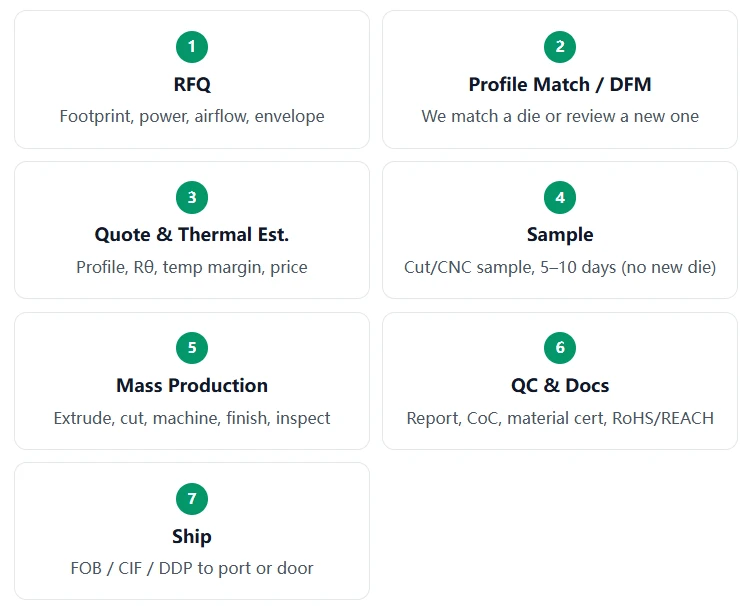
If an existing die already matches your envelope, we skip tooling entirely and samples can ship in 5–7 working days. A new custom die adds one-time NRE and lead time, which we confirm in the quote and amortize across your volume.
What Customers Say

M. Rossi
Power Supply Engineer, Italy

S. Haddad
Procurement, Lebanon

P. Kowalski
Lighting OEM, Poland
FAQ
Q: What is an extruded aluminum profile heatsink?
A: An extruded aluminum profile heatsink is a finned aluminum section made by forcing heated 6063/6061 billet through a die, producing a base and fins as one continuous piece. Standard families are flat-back straight-fin (most common), angle/L, and round. They cover most power-electronics, LED, drive, and inverter cooling at the lowest tooling cost and the highest repeatability.
Q: Extrusion vs skiving - which should I choose?
A: Pick an extruded aluminum cooling fin profile when a straight, angle, or round fin shape fits your device and you need volume - it is the lowest-cost, most repeatable route. Pick skived fins when flux density is too high or the envelope too tight for an extrusion, or when you need the thinnest, densest fins. See our technical-differences section above.
Q: Can you match an existing profile to avoid tooling?
A: Yes - this is the fastest, lowest-cost path. Send your envelope (length × width × base thickness × fin height/pitch) and hole pattern; we check our die library and, if a standard extruded heatsink profile fits, skip the new die entirely. Samples can then ship in 5–7 working days.
Q: How do you size the cooler to my device?
A: Send the device footprint, total dissipation in watts, ambient temperature, available envelope, and whether cooling is natural or forced-air. We either match a standard profile or propose a custom die, then return a surface-temperature estimate and margin before any tooling commitment.
Q: What quality documents do you provide?
A: Every batch ships with a material certificate, inspection report (base flatness, fin height/pitch, hole position, anodizing thickness, sample Rθ), and RoHS/REACH statement. We issue a Certificate of Conformity, and can supply PPAP-level documentation for automotive or grid programs on request.
Q: What is the MOQ and lead time?
A: Standard-profile samples (no new die) ship in 5–7 working days with a low prototype MOQ. New custom extrusions add one-time NRE and tooling lead time, confirmed in the quote. Volume repeats run on a scheduled basis with tiered pricing for 1,000+ programs.
Q: 6063, 6061, or copper for the profile?
A: For the extruded body, 6063-T5 is the default - it extrudes into fine fins and finishes well at the lowest cost. Use 6061-T6 when base stiffness matters, 1070 when you want a small conductivity gain, and reserve copper for a thin interface insert at the hottest spot, not the entire profile.
Hot Tags: extruded aluminum profile heatsink, China, suppliers, manufacturers, factory, customized, wholesale, buy, price, free sample, aluminum heatsink cooler, Extruded Aluminum Heat Sink with CNC Machining, heat sink extrusion, heat sink profile, special shaped heat sink, Special-shaped Aluminum Heat Sink Extrusion