

Circular Sunflower Heat Sink
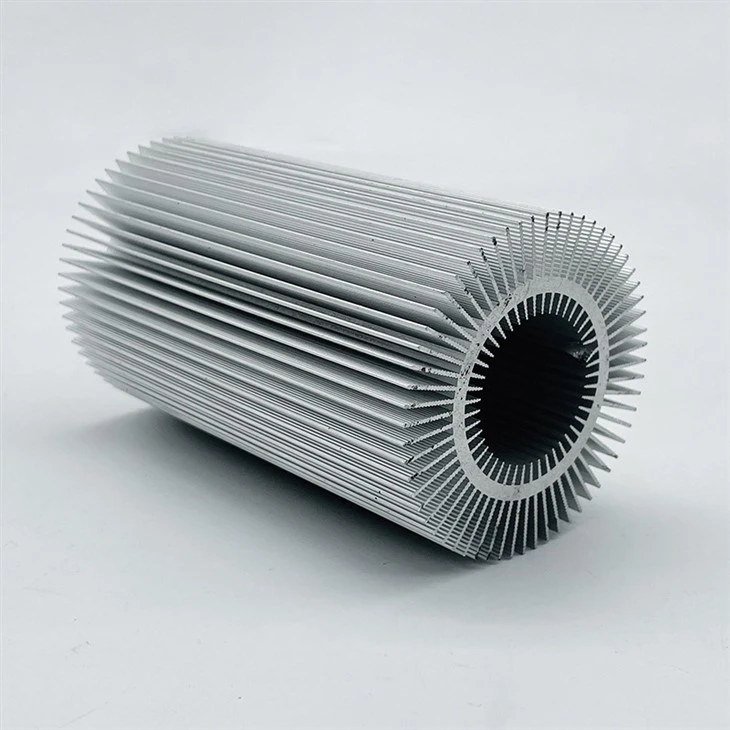
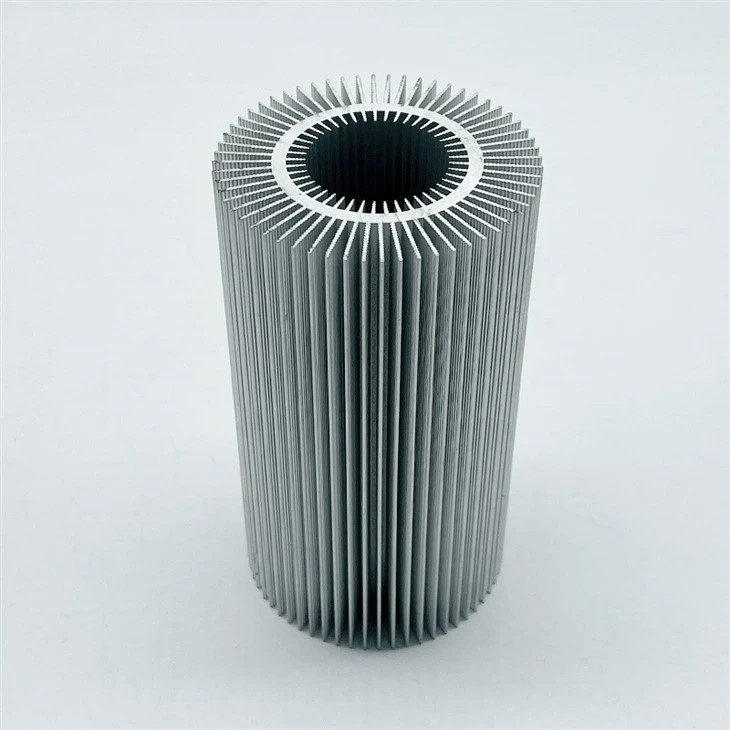
A circular sunflower heat sink is a 6063 aluminum extrusion with a hollow center bore and dense radial fins that radiate outward like the rays of the sun — giving it the "sunflower" name in the trade.

- Product Introduction
A circular sunflower heat sink is a 6063 aluminum extrusion with a hollow center bore and dense radial fins that radiate outward like the rays of the sun - giving it the "sunflower" name in the trade. The round body wraps around cylindrical power devices (high-power LEDs, servo motors, power modules, tubes), and the 360° fin array carries heat away by natural or forced convection in any orientation. We build these radial fin heat sinks to your outer diameter, bore size, fin density, and cut length.
- Hollow center bore - the device drops straight through; no bracket, no offset, short thermal path from source to fins
- 360° radial fins - convective surface on every side, so orientation and cross-flow direction barely matter
- One-piece 6063 extrusion - no bonded fins, no weld, light and cost-effective with high repeatability
- Fully customizable - outer diameter, inner bore, fin pitch/density, and cut length all to your drawing
Why a Round Sunflower Profile for Round Devices
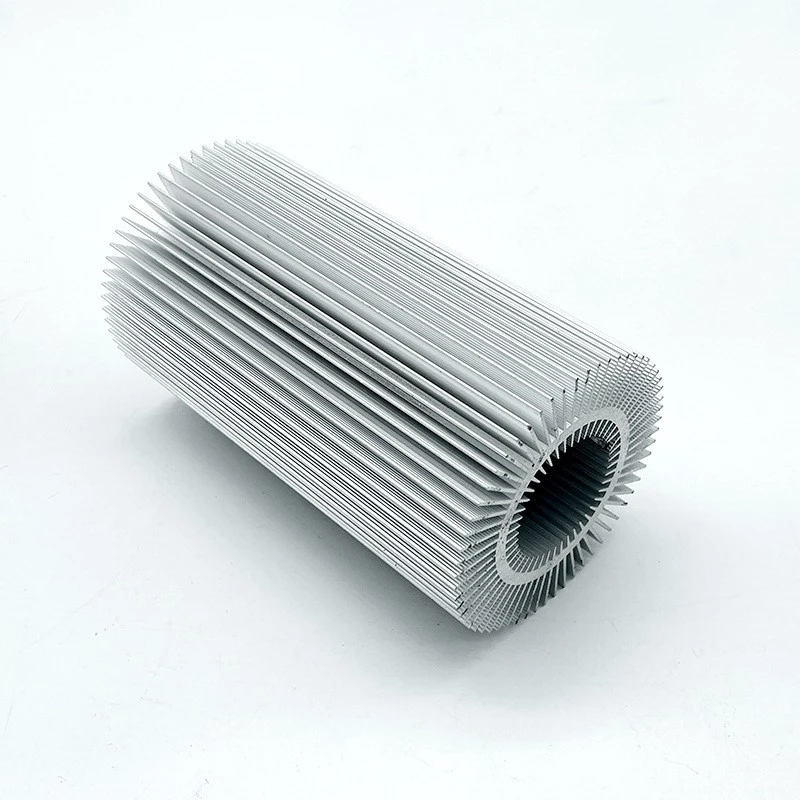
A circular sunflower heat sink solves a geometry problem other coolers create: most power devices that fail thermally are cylindrical - high-power LED COB arrays, servo-motor ends, power transistors, IGBT tubes, and sealed modules. A flat parallel-fin cooler forces you to clamp a round source onto a flat plate with a bracket, adding interface resistance and assembly steps. The radial cooler puts the source in the center bore so heat spreads outward uniformly into fins on every side.
Because the fins radiate in all directions, convection is nearly independent of orientation and cross-flow direction. In a sealed drum, a rotating motor, or a round luminaire housing, the round aluminum heat sink keeps working whether the airflow comes from one side or swirls around. That makes it the natural choice for omnidirectional cooling where a directional flat cooler would overheat on its blind side.
Engineering note for buyers: Send the device outer diameter, total dissipation (W), ambient temperature, available envelope (outer diameter and length), and whether cooling is natural or forced-air. We size the bore, fin height, fin density, and cut length, then return a case- or surface-temperature estimate and margin before tooling.
Product Overview
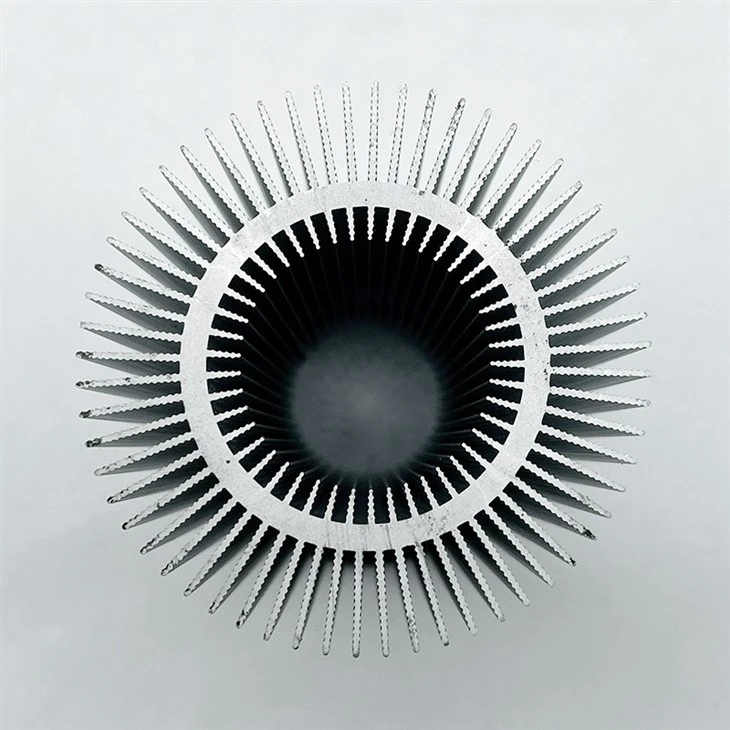
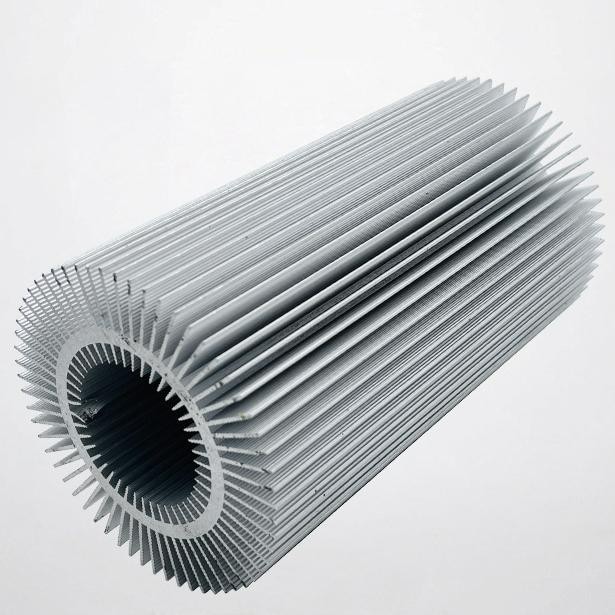
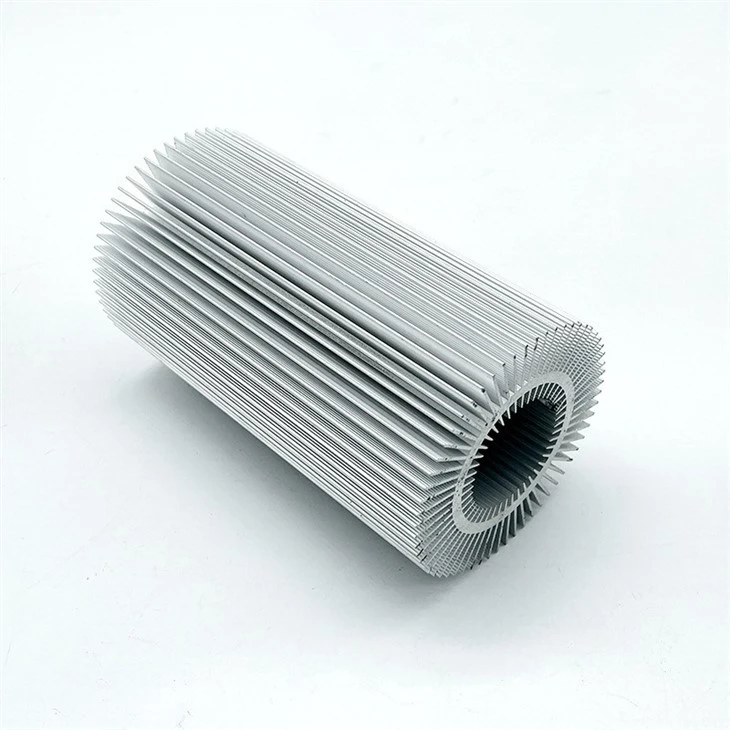
Three angles of the same radial cooler - the top view showing the sunflower fin pattern, a side section of the hollow tube wall and fins, and a mounted view with a cylindrical device dropped into the bore.
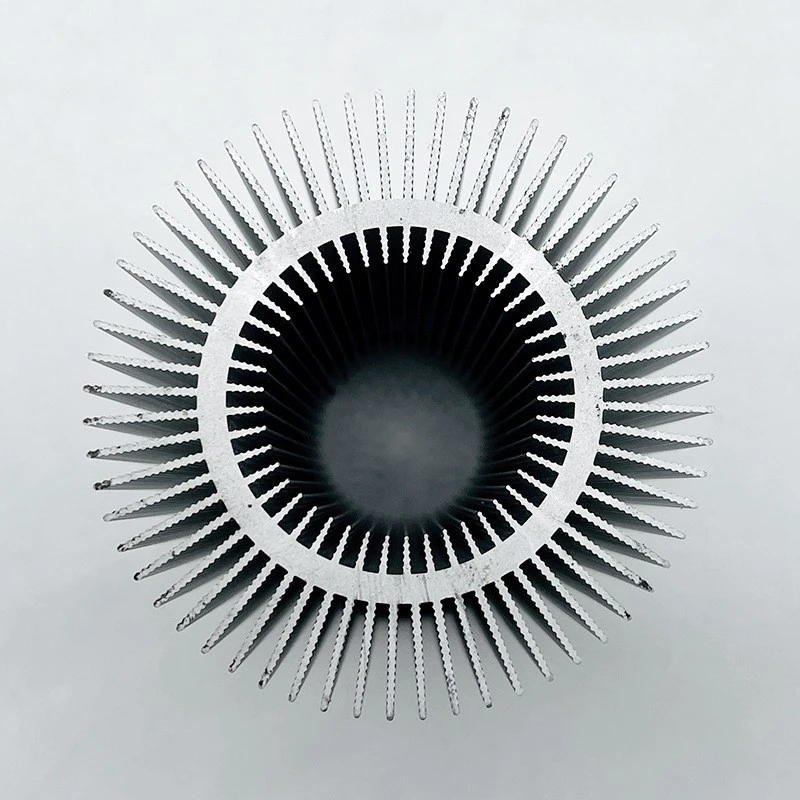
Top view
Radial fins radiating from a hollow center bore - the "sunflower" pattern.
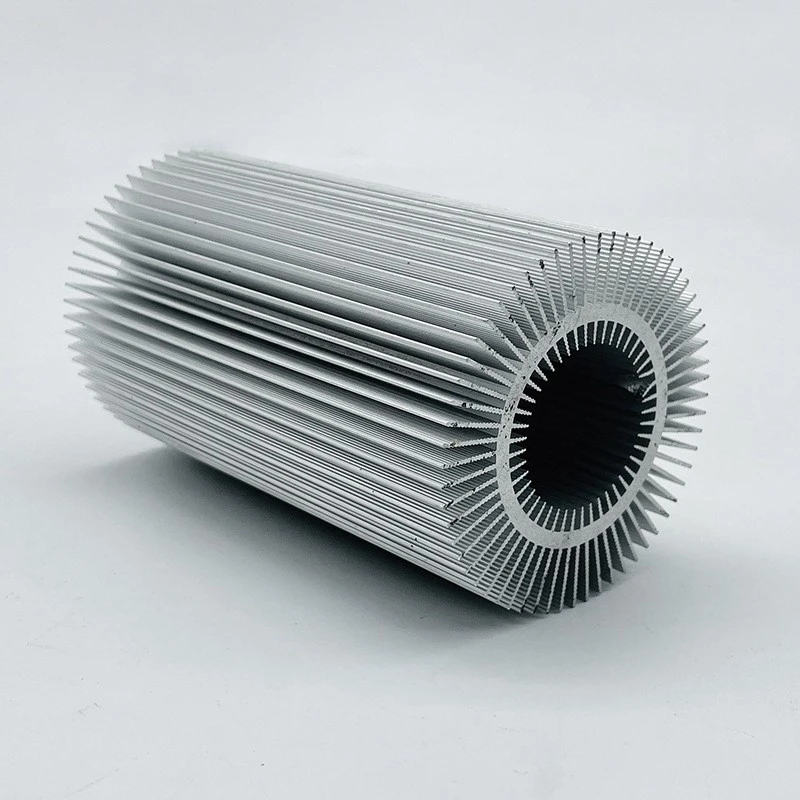
Side section
Hollow tube wall with radial fins attached on the outside; device sits inside the bore.

Mounted
Cylindrical device (LED, motor, tube) drops into the center; fins radiate around it.
Why Buyers Specify Our Water Cooled Heat Sinks
Fewer Parts, Lower Landed Cost
The hollow bore replaces the bracket and flat-plate interface other coolers need. One round extrusion instead of a cooler plus a mounting kit - fewer line items, simpler reordering.
For Procurement Teams
Sized to Your Device, Not a Guess
We match bore, fin height, fin density, and cut length to your cylindrical source and airflow, then return a surface-temperature estimate so you confirm margin before sign-off.
For Thermal & Mechanical Engineers
Drop-in Round Form Factor
LED modules, servo-motor ends, and power tubes seat straight into the bore. The 360° fins keep cooling even when the assembly rotates or airflow swirls.
For Luminaire / Motor OEMs
Stock & Private Label
Common outer-diameter / bore combinations kept in neutral or branded stock, with tiered pricing for recurring round-cooler programs across lighting and motion customers.
For Distributors
Technical Specifications
Reference radial fin heat sink build. Outer diameter, bore, fin density, and length are set to your device and envelope.
| Parameter | Specification |
| Base Material | Aluminum 6063-T5 (default); 6061-T6 on request |
| Profile Type | Circular radial-fin extrusion with hollow center bore ("sunflower") |
| Outer Diameter (OD) | 40-250mm typical; custom per envelope |
| Center Bore | Custom to device outer diameter (e.g., 10-120mm);tolerance ±0.1mm |
| Fin Height (radial) | 8-60 mm; matched to OD and airflow |
| Fin Density / Pitch | Custom fin count and pitch; tighter for forced air, wider for dusty or passive |
| Cut Length | 20-300 mm typical; saw cut to drawing |
| Wall / Base Thickness | Set so bore seats the device without flex; thicker for high power |
| Surface Finish | ~0.4–3.0 °C/W depending on OD, fin density, and airflow |
| Cooling Method | Natural convection (omni-directional) or forced-air |
| Certifications | RoHS, REACH compliant; ISO 9001 manufacturing |
Circular Sunflower Heat Sink Selection Guide
Match the round cooler to your cylindrical device, power, and cooling condition.
| Device/Application | Typical Power | Recommended Round Build |
| High-power LED lamp/COB array | 50-300 W | Hollow bore for LED module, natural-convection tall radial fins, black anodize |
| Servo/stepper motor end | 50-500 W | Bore to motor shaft-end diameter, forced or natural, concentricity-critical |
| Power module/transistor in tube | 30-400 W | Bore to device body, dense fins, forced-air for sealed cabinets |
| Inverter / converter round stage | 100-600 W | Larger OD, dense radial fins, forced cross-flow fan |
| Industrial round power module | 100-400 W | Mid OD, wider fin pitch for dusty shop air |
| Compact sealed enclosure device | Any | Black anodize for emissivity; fin density tuned to available height |
Technical Differences: Radial Fin vs Other Cooler Forms
A circular sunflower heat sink is one of several fin geometries. Picking the wrong one either wastes the round advantage (a flat cooler clamped to a round device) or over-spends (a liquid cold plate for a passively-cooled LED). Here is how the common forms compare for cylindrical and omnidirectional loads.
| Form | Best For | Limit | Relative Cost |
| Radial / sunflower fin (this page) | Cylindrical devices, omni-directional or rotating cooling | Needs round envelope; less directed airflow | Low-Med |
| Parallel / straight fin | Flat IGBT, power modules, directed forced air | Poor for round sources without a bracket | Low |
| Pin fin | Omni-directional but square footprint, high flux | Higher pressure drop; harder to extrude round | Medium |
| Skived fin | Highest flux density, compact, flat base | Not a round-form part; higher cost | Medium-High |
| Heat-pipe / liquid cold plate | Extreme density or sealed remote cooling | Far higher cost and complexity | High |
Rule of thumb: If your heat source is round or the assembly rotates / sits in swirling air, a radial fin heat sink with a hollow bore is usually the lowest-cost, cleanest solution. Choose a parallel-fin cooler when the device is flat and airflow is directed; move to skived or liquid cooling only when flux density exceeds what fins can handle.
Material & Fluid Comparison: 6063 vs 6061 vs Copper vs Die-Cast
The body material trades weight, cost, and conductivity. For most round coolers, extruded 6063 aluminum is the right call; copper is rarely justified and die-cast trades conductivity for shape freedom.
| Material | Thermal Conductivity | Density | Cost | When to Use |
| Aluminum 6063-T5 | ~209 W/m·K | 2.70 g/cm³ | Low | Default for radial extruded sunflower coolers |
| Aluminum 6061-T6 | ~167 W/m·K | 2.70 g/cm³ | Low-Med | When higher stiffness / strength is needed |
| Copper (C1100) | ~398 W/m·K | 8.96 g/cm³ | High | Interface plates only; almost never the whole round body |
| Die-cast aluminum (ADC12) | ~96 W/m·K | 2.66 g/cm³ | Medium | Complex non-extrudable shapes; lower conductivity |
Recommendation: Specify 6063-T5 for the bulk of your circular sunflower heat sink program - it extrudes cleanly into the radial profile, is light, and carries the typical case-to-air load at the lowest landed cost. Use 6061-T6 only when mechanical stiffness at the bore matters. Reserve copper for a thin interface insert, and avoid die-cast unless the shape cannot be extruded (its lower conductivity hurts fin performance).
Application
High-Power LED Lighting
COB arrays, flood, stadium, and grow lamps where the LED module drops into the bore and 360° fins cool passively.
Servo & Stepper Motors
Motor end-bells and brake resistors; the bore matches the shaft end, cooling holds while the motor turns.
Power Modules & Tubes
Transistors, rectifiers, and sealed power modules in a cylindrical package.
Inverters & Converters
Round-stage power devices in solar, energy-storage, and frequency inverters needing omni-directional fins.
Industrial Equipment
Round power modules on machinery where airflow direction is unpredictable.
Sealed / Rotating Assemblies
Drum housings, rotating joints, and sealed luminaires where orientation-independent cooling matters.
Manufacturing Process
From aluminum bar to a finished, device-ready radial cooler.
Extruded
6063 bar, radial fins+bore
Cut to Length
Sawn to your spec
CNC (opt.)
Counterbore, thread, flat
Anodize(opt.)
Natural or black
Deburr & Clean
Assembly-ready
Inspect
Bore, OD, finish
Quality Inspection (Testing & QC)
Every circular sunflower heat sink ships against an inspection plan tied to your device's bore fit and cooling requirement. Round-form QC focuses on the points that actually affect fit and thermal contact.
| Inspection Point | Method | Acceptance |
| Incoming material | Mill cert+spectrometer spot check | 6063/6061 per order; no off-grade alloy |
| Bore diameter & concentricity | CMM / bore gauge, runout check | Bore ±0.1 mm; concentric to OD within 0.15 mm |
| Outer diameter & roundness | CMM/ ring gauge | Per drawing, roundness within 0.1 mm |
| Fin straightness & density | Visual + gauge | No bent fins; pitch per drawing |
| Anodizing thickness | Eddy-current coating guauge | 8–15 µm typical; logged per batch |
| Thermal resistance (sample) | Bench test vs device simulation | Within quoted Rθ margin (report attached) |
| Visual & burr | 100% visual, deburr check | No sharp edge, no finish defect |
| CoC/traceability | Batch record | Material cert, inspection report, RoHS/REACH |
For buyers: Ask for the batch inspection report and material certificate with your first order - we issue a Certificate of Conformity (CoC) and can supply PPAP-level documentation for automotive or grid programs on request, including the bore concentricity record that matters most for round coolers.
Cost Factors
What drives the price of a radial fin heat sink - and how to specify one that meets the thermal budget without paying for unused capability.
| Factor | Effect on Cost | Buyer Tip |
| Material | 6063 < 6061 < die-cast < copper-insert | Stay 6063 unless bore stiffness forces 6061 |
| Outer diameter & fin height | More aluminum = higher unit cost | Size to real envelope, not worst-case |
| Bore size & tolerance | Tight concentricity adds inspection | Specify the tolerance you truly need |
| Fin density | Denser fins=more extrusion mass | Match pitch to airflow; don't over-fin |
| CNC machining | Counterbores, threads, flats add setup | Reuse a standard bore where possible |
| Anodizing | Black anodize adds a step | Natural finish is fine unless emissivity matters |
| Tooling / NRE | One-time for new radial die | Amortize across volume; ask about shared dies |
| Order quantity | Volume pricing at 1,000+ | Prototype MOQ is low; lock volume price early |
| Logistics | FOB vs DDP; carton vs crate | DDP simplifies import; consolidated shipments save freight |
Budget guidance: For a typical round LED or motor cooler, a 6063 extruded radial profile with standard bore is the lowest landed cost. Keep die-cast off the table unless the shape cannot be extruded (its lower conductivity hurts fin performance), and specify natural (not black) anodizing unless emissivity is a real factor.
Customize Process
From your device drawing to a finished, drop-in radial cooler. A typical circular sunflower heat sink program runs in seven steps.
RFQ
Device OD, power, airflow, envelope
DFM Review
We check bore, OD, fin feasibility
Quote & Thermal Est.
Profile, R, temp margin, price
Sample
CNC-modified or new-die sample, 5-10 days
Mass Production
Extrud, cut, machine, finish, inspect
QC & Docs
Report, CoC, material cert, RoHS/REACH
For modified standard radial profiles we skip the new-die step, so samples can ship in 5–7 working days. Full custom extrusions add tooling lead time, which we confirm in the quote.
What Customers Say

R. Castillo
Lighting Engineer, Mexico

K. Nowak
Mechanical Engineer, Poland

T. Abebe
Procurement, Ethiopia
FAQ
Q: What is a circular sunflower heat sink used for?
A: A circular sunflower heat sink cools cylindrical power devices - high-power LEDs, servo/stepper motors, power transistors, tubes, and round power modules. The hollow center bore lets the device sit inside the cooler, and the 360° radial fins carry heat away by natural or forced convection in any orientation. If your heat source is round or the assembly rotates, this form beats a flat cooler.
Q: Radial fin vs parallel fin - which should I pick?
A: Pick a radial fin heat sink (sunflower) when the device is cylindrical, the assembly rotates, or airflow swirls from any direction - the 360° fins cool regardless of orientation. Pick a parallel/straight-fin cooler when the device is flat (IGBT base, power module) and airflow is directed. See our technical-differences section above.
Q: Can you customize the bore and outer diameter?
A: Yes. The bore is cut to your device outer diameter with ±0.1 mm tolerance and held concentric to the OD within 0.15 mm; outer diameter, fin height, fin density, and cut length are all set to your drawing. We can also add counterbores, threads, or flats by CNC.
Q: How do you size the cooler to my device?
A: Send the device outer diameter, total dissipation in watts, ambient temperature, available envelope (OD and length), and whether cooling is natural or forced-air. We match bore, fin height, fin density, and length, then return a surface-temperature estimate and margin before tooling.
Q: What quality documents do you provide?
A: Every batch ships with a material certificate, inspection report (bore concentricity, OD/roundness, fin density, anodizing thickness, sample Rθ), and RoHS/REACH statement. We also issue a Certificate of Conformity, and can supply PPAP-level documentation for automotive or grid programs on request.
Q: What is the MOQ and lead time?
A: Modified-profile radial samples ship in 5–7 working days with a low prototype MOQ. New extrusions add tooling lead time, confirmed in the quote. Volume repeats run on a scheduled basis with tiered pricing for 1,000+ programs.
Q: Aluminum or copper for the round body?
A: For the whole round body, extruded 6063 aluminum is almost always right - it is light, low-cost, and carries the typical case-to-air load. Copper is ~3× the cost and weight for a small gain, so we reserve it for a thin interface insert at the hottest spot, not the entire sunflower cooler.
Related Heat Sink Pages
Aluminum Sunflower Radiator Profile
Custom Sunflower Round LED Heat Sink
Round Aluminum Extruded Heat Sink
Precision Round Aluminum Heat Sinks
Hot Tags: circular sunflower heat sink, China, suppliers, manufacturers, factory, customized, wholesale, buy, price, free sample, Aluminum Heat Sink Extruded for LED Light, Aluminum Heat Sink for Ufasoft Coin, half round heat sink, LED cooler, Motor Heat Sink, Ufasoft Coin cooler